3-Minute Pitch Checklist: 10 Key Steps to Succeed
The ultimate methodological guide to structure and deliver an impactful pitch in exactly 180 seconds.
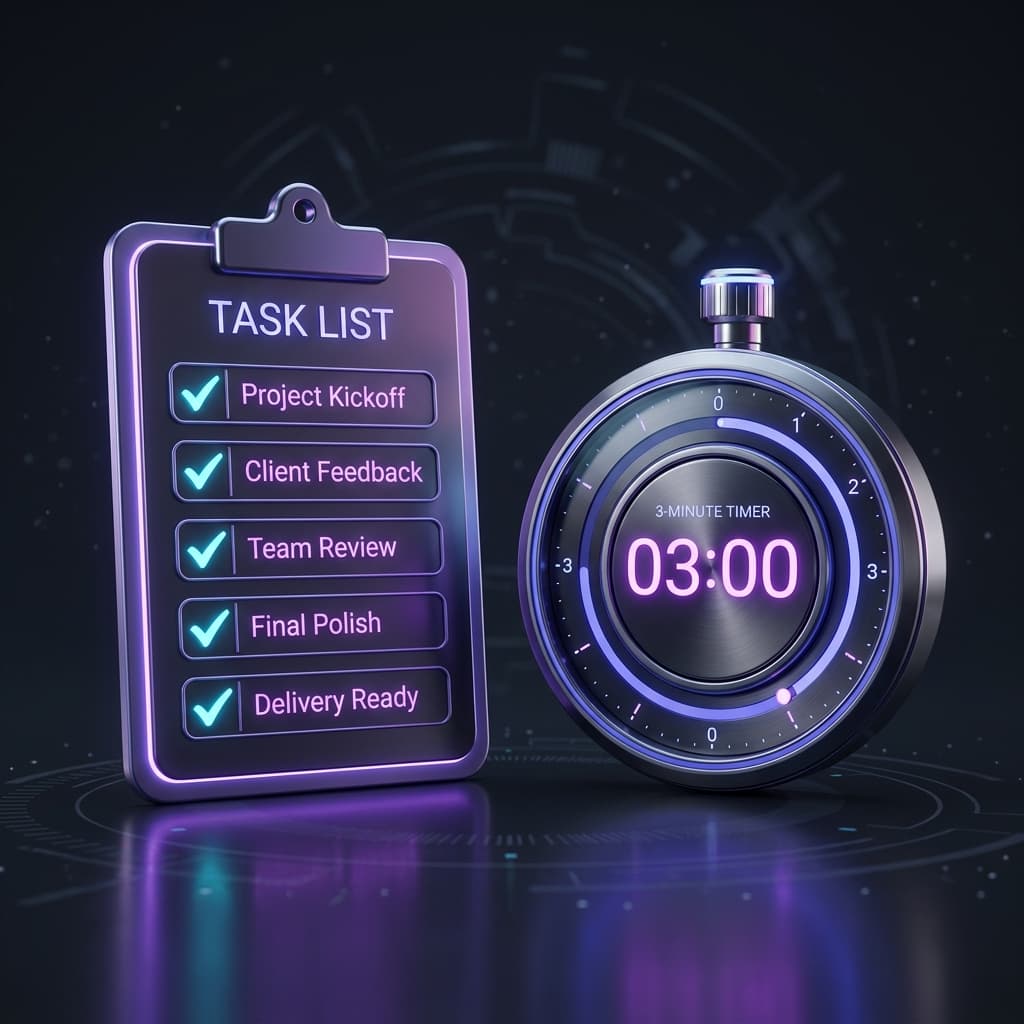
You have 180 seconds to convince. Not one more. Whether presenting a project to a steering committee, pitching to investors, or capturing a prospect's interest, a short pitch is the ultimate communication challenge.
To help you master this demanding format, we have designed this 10-point checklist to transform your oral presentation into a powerful tool of conviction.
Structural Preparation (Before You Speak)
The success of a 3-minute pitch depends 80% on its structure. Every single second must be optimized.
- The Hook (0 - 30s): Capture attention immediately. Start with a compelling question, an unexpected statistic, or a short story (storytelling). Avoid starting with long corporate introductions.
- The Problem (30s - 1m): Clearly identify the problem (the pain point) your target face. It must be understandable in simple terms.
- The Solution (1m - 1m30): Present your solution simply and concisely. What concrete benefit does it bring? Avoid overly complex technical jargon.
- The Evidence (1m30 - 2m): Bring concrete proof (key figures, traction, case studies, client feedback). This is what makes your solution credible.
Oratorical Delivery (During the Pitch)
The substance of your message matters, but the delivery determines how it will be received by your audience.
- Pacing Modulation: Avoid speaking in a monotone voice. Speed up slightly during the solution description to show enthusiasm, and slow down on key figures to emphasize facts.
- Body Language: Maintain an upright and open posture. Look at your audience (or the camera lens if you are presenting remotely). Open gestures reinforce your message.
- Embracing Pauses: Do not fear silence. Marking a 2-second pause after a key sentence gives it considerable weight and allows your audience to digest it.
- Voice Projection: Speak with confidence and clarity. Articulate every syllable and project your voice by breathing from the diaphragm to establish your natural authority.
The Conclusion (After You Speak)
The final seconds of your pitch are what will remain engraved in your audience's memory.
- Call-to-Action (CTA): Be explicit about what you expect from your audience after the pitch (scheduling a meeting, validating a budget, signing a partnership).
- The Closing Statement: End with a strong and memorable closing sentence (a punchline). Never finish with a weak "Well, that's all from me".
The Art of Stress Management Before Entering the Stage
Knowing how to structure your ideas is crucial to succeed, but managing physical stage fright is equally important. In the minutes leading up to your pitch, perform a few deep diaphragmatic breaths (using the box breathing technique). Inhale for 4 seconds, hold your breath for 4 seconds, exhale for 4 seconds, and wait for 4 seconds before inhaling again. This will instantly slow your heart rate and ground your voice.
Want to practice pitching under the eyes of an impartial virtual jury? Test our timed pitch simulator on Eloqu'IA.
Ready to master your next interview?
Eloqu'IA combines multi-agent AI recruiters and real-time speech analysis to help you excel during critical job interviews and business meetings.
Related Articles
View all articles →Beating the ATS Filter: How to Boost Your Resume Match Score from 42% to 90%
Why 75% of qualified resumes are filtered out before human review, a...
Construction & Trades Automation: Voice-to-Quote, Invoice Chasing & Job Site Tracking
Electricians, plumbers, contractors, and construction SMEs: save 10 ...
Executive Salary Negotiation: Exact Scripts to Secure a 15% Higher Package
Psychological anchoring, strategic silence after naming your number,...